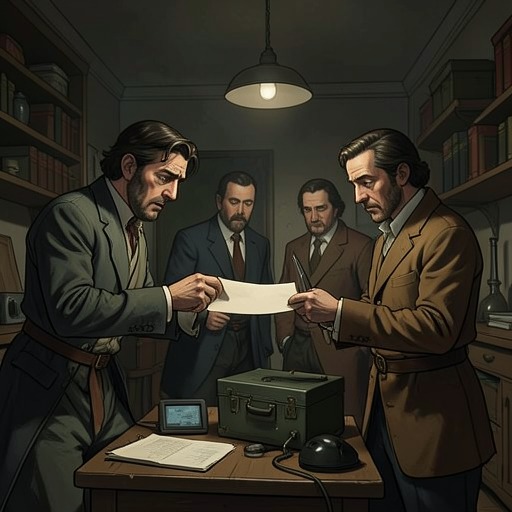
Tiuri and Edwinem: Tiuri Inherits the Ring and Mission
De brief voor de KoningTiuri and Edwinem are bound by a charge that survives Edwinem’s death. Edwinem sends Tiuri toward King Unauwen with a mission and his ring; Tiuri continues in his place, guarding the secret entrusted to him while carrying the cost of Edwinem’s murder. Their relationship thus becomes the story’s test of fidelity: Tiuri cannot restore the knight who gave him the task, but he can finish what Edwinem began.
The mission inherited
At the outset, Tiuri is a sixteen-year-old among five young men keeping the night vigil before the expected knighting ceremony. The ritual requires a full day without food or drink and a sleepless night in a small chapel, where the candidates reflect on their duties and resolve to serve their king and homeland, act honestly and helpfully, and fight for what is good. That formal preparation supplies a standard against which Tiuri’s later conduct can be measured. Edwinem’s mission draws him away from the expected course: rather than advance toward knighthood by completing the prescribed vigil and ceremony, Tiuri accepts a responsibility that places another person’s urgent need before his own prospects.
The later account makes the personal connection explicit. Tiuri tells the toll lord that Edwinem came from Eviellan and was traveling toward King Unauwen when he gave Tiuri his ring and sent him onward. Tiuri confirms that he is still traveling to the king. He does not present himself as Edwinem’s equal or claim the knight’s place by status; he describes himself as traveling in Edwinem’s stead. The distinction matters. Tiuri inherits the task, not Edwinem’s identity, and must make the inherited duty credible through his own choices.
The ring and the truth of Edwinem’s death
The ring gives the relationship a visible, portable token. Tiuri recalls that King Unauwen gave such rings to his most trusted paladins, and he identifies Edwinem as the person from whom he received this one. The toll lord understands what the object implies and presses Tiuri to explain when and why Edwinem gave it to him. His questions turn a private trust into a matter that must be established before another person who recognizes the ring’s significance.
The exchange also brings Edwinem’s death into the open. Asked whether Edwinem is dead, Tiuri answers that he is. He explains that the Red Riders and their master, the Black Knight with the Red Shield, murdered him after luring him into a trap. Edwinem had been killed in a forest near the City of Dagonaut, while traveling from Eviellan toward King Unauwen. The toll lord shows no outward shock or grief, but closes his hand around the ring so tightly that his knuckles whiten. The gesture gives the news a weight his controlled manner does not express aloud.
Tiuri does not tell the toll lord everything. Although he explains Edwinem’s death and the journey he inherited, he withholds the letter’s contents. This restraint defines the trust between the two knights as more than a simple transfer of an object: Tiuri has to preserve the mission’s secrecy as well as carry its proof. The ring can be shown; the letter cannot be disclosed.
Carrying Edwinem’s place
The ring becomes practical evidence during Tiuri’s dealings with the toll lord. Tiuri offers it as a pledge, though the toll lord points out that it is not Tiuri’s to give. Tiuri’s answer is that Edwinem would have done the same, because Tiuri is traveling in his place. His reasoning does not erase the distinction between owner and bearer. Instead, he accepts the burden of acting responsibly with something entrusted to him, even when the situation demands that he risk it.
That claim is tested on the road rather than settled by explanation. In the mountains, Tiuri and Piak wait at a sheltered stone while the mist shifts across the landscape. They eat a little bread; after about half an hour the sun appears, and they set out again. The episode does not repeat Edwinem’s instructions, but it places Tiuri’s continuation of the mission in the concrete conditions of travel: waiting for visibility, choosing a route, and pressing onward. The inherited duty persists through these ordinary decisions, not only through dramatic declarations.
A promise fulfilled through action
At the end of the journey, King Dagonaut explains that Tiuri’s response to a request for help has changed the meaning of the knighting he expected. Had Tiuri refused the request, he would already have been a knight; because he accepted it, completed the mission, and fulfilled his promise to Edwinem, the king says that Tiuri has shown himself to be one. The point is not that the ceremony is meaningless. King Dagonaut still performs it: Tiuri kneels, receives the sword’s flat blow to the neck, and is told to rise as a knight. But the formal act recognizes a quality that Tiuri has already demonstrated through the mission.
The king then gives Tiuri a white shield at King Unauwen’s request. It marks Tiuri’s service to both kings and recalls the knight whose task he took over. The gift makes the connection public and lasting: Edwinem’s work is complete, but the relationship remains legible in the shield Tiuri carries. In this way, Tiuri’s bond with Edwinem joins private fidelity to public recognition. He does not become Edwinem; he becomes accountable for the promise that Edwinem placed in his hands.
The vigil after the journey
Tiuri’s final vigil echoes the night at which the story began, but he returns to it changed. Kneeling alone in the chapel, he briefly imagines that his friends are still there and that the events since his first vigil might have been a dream. The white shield hanging above the altar confirms that the journey was real. He understands that the Tiuri keeping this later vigil is not the same as the young man who began it: what he has endured, the people he has met, and the friends he has made have become part of his understanding of knighthood.
His reflection gives Edwinem’s role its final measure. Tiuri thinks of the experiences through which he has passed and resolves to try to be a good knight. The promise to Edwinem has not ended with the delivery of the mission or the king’s recognition. It has become part of how Tiuri understands the work ahead. The ring first carried the absent knight’s authority; the shield now records the responsibility Tiuri has made his own.